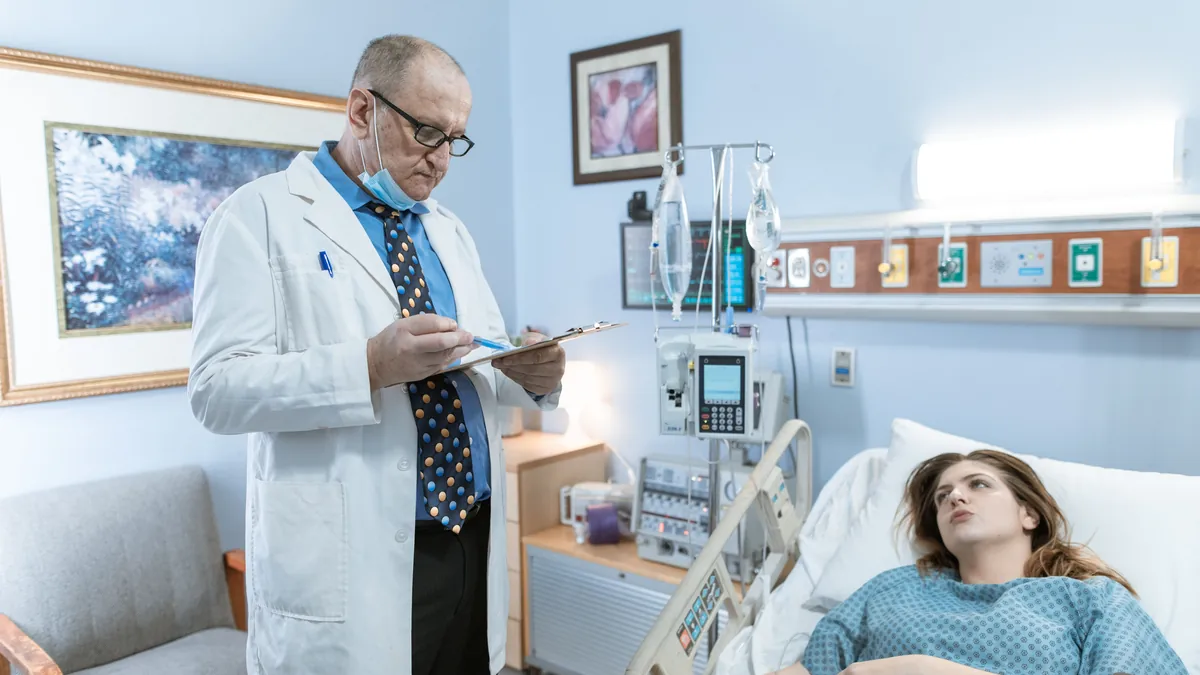
A care building hurts people through gaps in its physical plant: a call button a resident cannot reach from the floor, a floor wet at 6 a.m. every day, a corridor nobody walks, an exit blocked on third shift. A physical-plant safety review looks for exactly these, because the building is where a fix is cheapest and easiest to confirm.
A handrail that ends six feet short of a door is not a cosmetic defect. It is a decision that somebody will fall there, made in advance and left in place.
How common are falls and harm among older adults?
The CDC reports that more than one in four adults aged 65 and older — over 14 million people — report falling each year. It also reports that the age-adjusted fall death rate among adults 65 and older rose 21 percent between 2018 and 2024, from 64.7 to 78.4 per 100,000.
Inside skilled nursing facilities specifically, the most recent national incidence study is the HHS Office of Inspector General’s review of Medicare SNF stays sampled in August 2011: an estimated 22 percent of beneficiaries experienced adverse events during their stays, a further 11 percent experienced temporary harm, and physician reviewers judged 59 percent of those events clearly or likely preventable.
Two honest caveats. The OIG figures describe 2011 stays — they are the most recent national estimates of their kind, and their age is itself worth noticing. And the CDC fall-death figures quoted here are age-adjusted rates; they are not interchangeable with crude rates published elsewhere, and mixing the two produces a trend that does not exist.
What building hazards cause falls in a nursing home?
Not “does this building meet code.” The question is: how does this building hurt someone, given who lives here and how the day runs? Those produce different lists.
- Continuity, not presence. A handrail exists. Does it run the whole corridor, including past the alcove and around the corner? The gap is where the fall happens.
- Reach, not installation. A call button is mounted. Can the person reach it from the bed, from the chair, and from the floor?
- Time of day. A floor that is wet at 6 a.m. every day because that is when the ice machine runs is a scheduled hazard, not an incident.
- The corridor nobody walks. The one that leads to storage. Nobody on staff has a reason to go there, so nobody has looked at it in months.
- Shift-dependent behavior. An exit that is clear on first shift and blocked on third is not an exit.
Why fix the building first?
Clinical practice is hard to change and slow to verify. A building is neither. A handrail can be extended in an afternoon and the fix can be confirmed by walking back to it.
That is the whole argument for treating the physical plant as a first-class safety category rather than a maintenance item: it is the part of the harm chain where intervention is cheapest and confirmation is easiest.
How can families help prevent falls in a nursing home?
If you have a relative in a facility, visit at unpredictable hours and walk somewhere other than their room. Look at the corridor, the bathroom, the floor and the call cord. A resident with a visitor who notices things is materially safer than one without.
If you see something, CareGuard runs a confidential channel for families, staff and visitors: report a concern. If someone is in immediate danger, call 911; if you need a regulator, that is your state survey agency, your long-term care ombudsman, or Adult Protective Services.
Frequently asked questions
What are five ways to prevent falls in a nursing home building?
A physical-plant review checks five things. Handrails run the whole corridor, with no gap past an alcove or around a corner. Call buttons can be reached from the bed, the chair and the floor. Floors are not wet on a schedule, such as at 6 a.m. when the ice machine runs. Unused corridors get walked. Exits stay clear on every shift, not only the first.
How common are falls in older adults?
The CDC reports that more than one in four adults aged 65 and older, over 14 million people, report falling each year. The age-adjusted fall death rate among adults 65 and older rose 21 percent between 2018 and 2024, from 64.7 to 78.4 per 100,000. Those are age-adjusted rates, and they should not be mixed with crude rates published elsewhere.
Is a nursing home that meets code a safe building?
Not necessarily. Meeting code and being safe produce different lists. A review asks how the building hurts someone, given who lives there and how the day runs. A handrail can exist and still end six feet short of a door, and a call button can be installed and still be out of reach from the floor. The gap is where the fall happens.
Where do I report a safety concern at a nursing home?
CareGuard runs a confidential channel for families, staff and visitors: report a concern. If someone is in immediate danger, call 911. If you need a regulator, contact your state survey agency, your long-term care ombudsman, or Adult Protective Services. A resident with a visitor who notices things is materially safer than one without.
Sources
Every figure on this page is traceable. Where a source is a government report, the year the data describe is named alongside it, because it is usually not the year of publication.
- Centers for Disease Control and Prevention. Facts About Falls and Older Adult Falls Data, Older Adult Fall Prevention, pages dated January 27, 2026 and February 26, 2026. cdc.gov
- U.S. Department of Health and Human Services, Office of Inspector General. Adverse Events in Skilled Nursing Facilities: National Incidence Among Medicare Beneficiaries. Report OEI-06-11-00370, February 27, 2014. Data describe a sample of Medicare SNF stays in August 2011. oig.hhs.gov